


What Large Format Printing Covers #
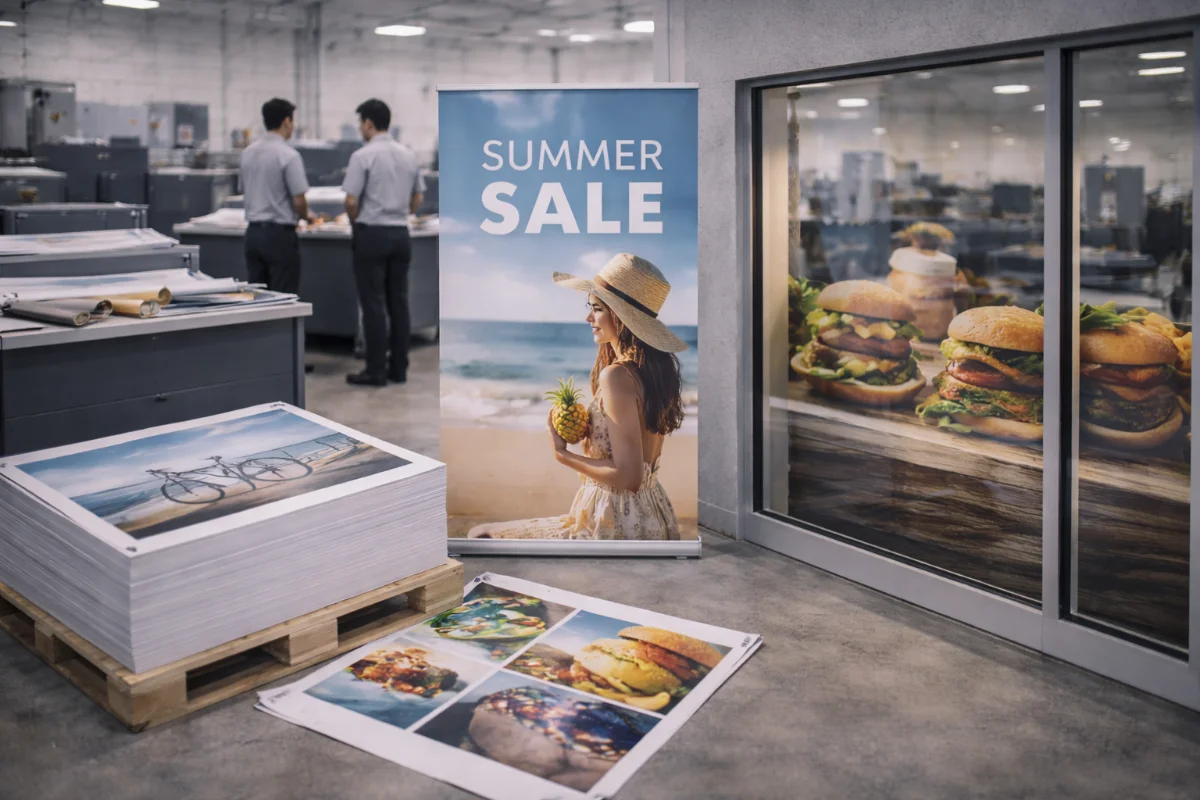
Large format printing refers to the production of oversized graphics typically used for visibility at distance, wayfinding, promotions, or installations. These items are printed on wide-format inkjet equipment and can be mounted, laminated, or assembled depending on application.
Common large format outputs include:
-
Posters
-
Pull-up and roll-up banners
-
Foam board or PVC boards
-
Exhibition panels
-
Backdrops
-
Window graphics
-
Floor decals
-
Outdoor signage
-
Hoardings
Because of their size, materials, and finishing requirements, large format projects involve different planning considerations compared to standard flyers or brochures.
Typical Business Use Cases #
Large format printing is widely used across industries for:
Retail Promotions #
-
In-store posters
-
Sale signage
-
Window decals
-
Seasonal campaigns
Events and Exhibitions #
-
Booth backdrops
-
Directional signage
-
Sponsor boards
-
Product panels
Corporate Communications #
-
Lobby displays
-
Office branding
-
Wall murals
-
Safety signage
Construction and Property Marketing #
-
Site hoardings
-
Project boards
-
Wayfinding signs
-
Unit layouts
Temporary Campaigns #
-
Pop-up stores
-
Roadshows
-
Product launches
Each scenario places different demands on durability, viewing distance, and installation method.
Common Materials Used in Large Format #
Large format printing supports a wide range of substrates.
Paper-based materials:
-
Photo paper
-
Blueback poster paper
-
Synthetic poster stocks
Rigid boards:
-
Foam board
-
PVC board
-
Acrylic (for premium displays)
-
Honeycomb board
Flexible media:
-
PVC banner material
-
Fabric
-
Canvas
-
Adhesive vinyl
Material selection depends on whether the display is temporary or long-term, indoor or outdoor, and whether it must be lightweight or rigid.
Indoor vs Outdoor Applications #
Indoor Displays #
Indoor signage usually prioritises:
-
High image quality
-
Low glare finishes
-
Lightweight boards
-
Clean edges
Lamination is often optional unless items will be handled frequently.
Outdoor Displays #
Outdoor applications require:
-
Weather-resistant inks
-
Waterproof substrates
-
UV protection
-
Strong mounting systems
-
Edge reinforcement or eyelets
Outdoor jobs usually involve lamination or specialised coatings to extend lifespan.
Finishing and Mounting Options #
Finishing transforms printed sheets into ready-to-install displays.
Common finishing steps include:
-
Lamination for durability
-
Trimming and contour cutting
-
Eyelet installation for banners
-
Mounting onto boards
-
Framing
-
Panel joining for oversized builds
-
Velcro or magnetic backing
-
Double-sided adhesive tape
Mounting adds rigidity but also increases weight and transport considerations.
Artwork Preparation for Large Format #
Because prints are viewed from further away, design priorities differ from small-format materials.
Key preparation rules include:
-
Use high-resolution images appropriate for final size
-
Design at scale or in proportion
-
Extend backgrounds into bleed areas
-
Avoid placing text too close to edges
-
Use thicker strokes
-
Increase font sizes for legibility
-
Supply vector logos where possible
Designers should confirm final display dimensions and viewing distance before finalising layouts.
Resolution and Viewing Distance #
Large format prints are not always produced at the same DPI as brochures.
Posters viewed at distance can tolerate lower resolution than hand-held materials, but files must still meet minimum production standards.
Supplying overly low-resolution images remains one of the most common causes of large format rework.
Timeline Planning for Large Format Jobs #
Large format projects often take longer than expected due to:
-
Ink curing time
-
Lamination drying
-
Board mounting
-
Panel assembly
-
Packing and crating
-
Courier size restrictions
For campaigns with fixed deadlines, artwork should be locked early and buffer days added for finishing and logistics.
Rush services may be available for simple posters or banners but become limited once mounting or multi-panel builds are involved.
Transport and Installation Considerations #
Oversized items introduce logistical challenges.
Before production, confirm:
-
Maximum vehicle dimensions
-
Lift access at delivery location
-
Venue loading bay rules
-
Installation windows
-
Storage capacity
-
Protection during transit
Failure to plan transport can delay deployment even if printing is completed on time.
When RFQ Is Recommended #
Large format jobs are usually routed through RFQ when they involve:
-
Custom sizes
-
Multi-panel installations
-
Large quantities
-
Outdoor durability requirements
-
Mixed materials
-
Installation services
-
Tight venue schedules
RFQ review allows production teams to coordinate printing, finishing, and logistics accurately.
Common Mistakes to Avoid #
Typical problems include:
-
Designing too close to edges
-
Supplying low-resolution images
-
Forgetting eyelet or mounting requirements
-
Choosing reflective finishes for text-heavy signage
-
Ignoring transport limits
-
Requesting outdoor durability for indoor-only materials
Early planning avoids costly reprints.
Summary #
Large format printing supports banners, boards, exhibition displays, and signage for retail, corporate, and event use cases.
Successful projects depend on selecting suitable materials, preparing artwork correctly, allowing sufficient finishing time, and planning logistics early.
Understanding these factors helps businesses deploy large format displays smoothly — without last-minute production or delivery issues.


