


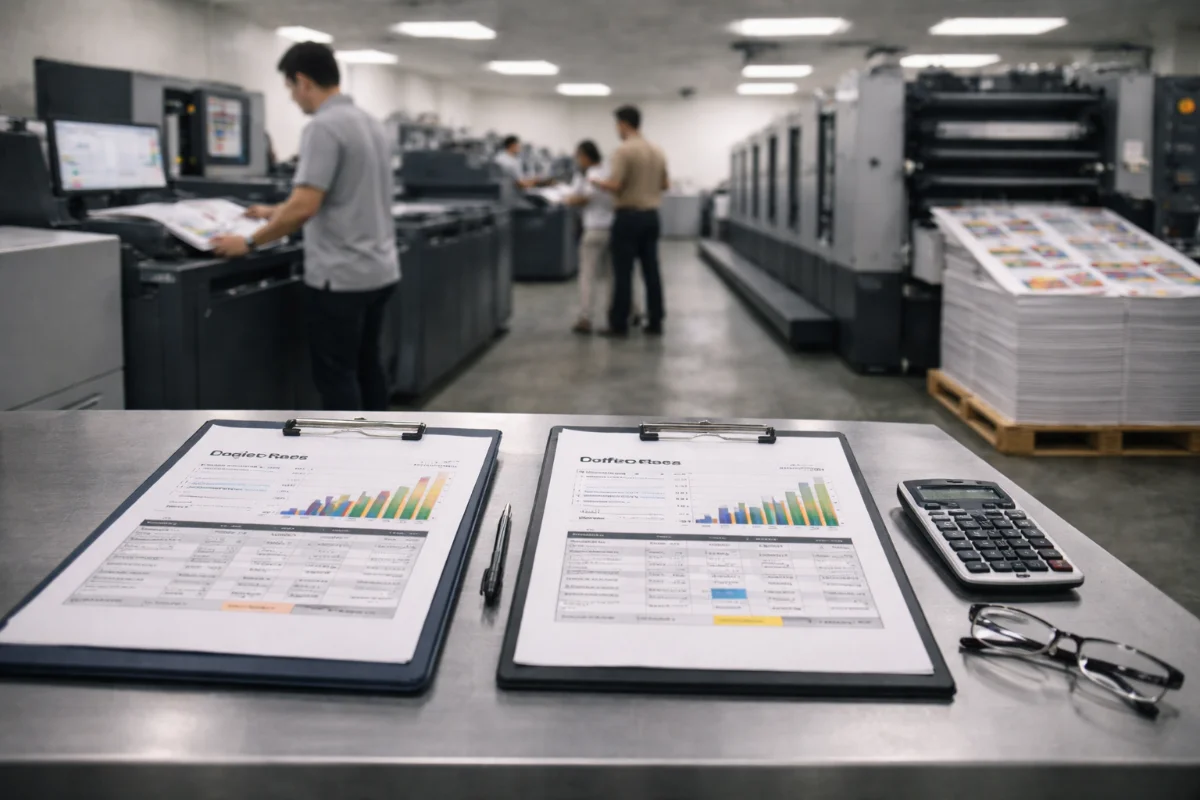
Understanding Cost Breakpoints in Commercial Printing #
In commercial printing, “cost breakpoint” refers to the quantity range at which one printing method becomes more economical than another. Most commonly, this comparison involves digital printing and offset printing.
Digital printing typically has low setup costs and is well suited to short runs. Offset printing involves higher initial setup — including plate creation and press preparation — but delivers lower per-unit costs as quantities increase.
Knowing where this cost crossover occurs helps businesses select the most efficient production method and avoid paying more than necessary for a given project.
How Digital Printing Is Priced #
Digital printing uses toner- or inkjet-based presses that require minimal setup time. Files are sent directly to the press, which eliminates plate making and extensive calibration stages.
Digital pricing usually reflects:
-
Click charges per sheet
-
Toner or ink usage
-
Paper consumption
-
Basic finishing steps
-
Labour for setup and handling
Because these costs scale almost linearly with quantity, digital printing is generally economical for:
-
Short runs
-
On-demand reprints
-
Personalised materials
-
Prototypes and test batches
-
Time-sensitive projects
However, as quantities increase, the per-sheet cost remains relatively stable rather than dropping dramatically.
How Offset Printing Is Priced #
Offset printing involves transferring ink from metal plates onto paper via rubber blankets. Preparing an offset job requires:
-
Plate output
-
Press setup and calibration
-
Ink matching
-
Make-ready sheets
-
Wash-ups between jobs
These upfront activities create higher initial costs compared to digital printing.
Once presses are running, however, the per-sheet cost is significantly lower, especially for long runs. This makes offset more cost-effective for:
-
High-volume brochures
-
Catalogues
-
Magazines
-
Corporate stationery sets
-
Packaging components
The longer the run, the more the setup cost is spread across each piece.
Where the Breakpoint Typically Occurs #
There is no single universal quantity where digital switches to offset. The breakpoint depends on:
-
Sheet size
-
Colour coverage
-
Paper stock
-
Number of pages
-
Finishing steps
-
Press availability
-
Urgency
In many standard scenarios, the crossover may occur anywhere from a few hundred to several thousand copies.
For example:
-
A simple A5 flyer on standard paper may move to offset at a lower quantity.
-
A complex multi-page booklet may stay digital longer.
-
A job with heavy ink coverage or premium paper may reach the breakpoint sooner.
These ranges are indicative rather than fixed and must be evaluated case by case.
Other Factors That Influence the Breakpoint #
Paper Stock #
Specialty or heavyweight papers can affect both methods differently. Some stocks run efficiently on digital presses, while others require offset equipment. Limited stock availability can also force a method choice regardless of quantity.
Finishing Requirements #
Processes such as lamination, Spot UV, die-cutting, and binding add costs that may outweigh the difference between print methods. In some cases, finishing becomes the dominant cost factor, making the print method less significant in the overall calculation.
Colour Accuracy and Consistency #
Offset printing offers strong colour control over long runs, which can be important for brand-sensitive projects. Achieving similar consistency digitally across very large quantities may require extra calibration or segmented runs.
Personalisation #
Variable data printing — such as unique names or QR codes — is usually far more economical on digital presses. Offset can support personalisation only with additional processes, which often removes its cost advantage.
Turnaround Requirements #
Urgent projects may remain digital even at higher quantities because:
-
Plates take time to produce
-
Offset presses are booked in advance
-
Drying times apply
Speed can override cost efficiency in deadline-driven situations.
Why Online Pricing Systems Use Thresholds #
Online ordering platforms typically route jobs to RFQ when quantities or specifications exceed predefined limits. These thresholds exist because:
-
Breakpoints vary by configuration
-
Press capacity changes daily
-
Finishing queues fluctuate
-
Paper pricing shifts
-
Tooling may be required
Manual review ensures the most cost-effective and technically feasible method is chosen before pricing is confirmed.
Choosing the Right Method for Your Project #
Digital printing is generally suitable when:
-
Quantities are low to moderate
-
Speed is critical
-
Personalisation is required
-
Test runs are needed
-
Frequent reorders are expected
Offset printing is usually preferable when:
-
Quantities are high
-
Unit cost is a priority
-
Long-run colour consistency matters
-
Standardised designs are used
-
Multiple items can be ganged efficiently
When projects sit near the breakpoint, requesting technical advice or an RFQ allows production teams to calculate the most economical option.
Summary #
Digital and offset printing follow different cost curves. Digital excels at short runs and rapid turnaround, while offset becomes increasingly economical as quantities rise.
The exact cost breakpoint depends on product size, paper stock, finishing requirements, and schedule constraints. Understanding these dynamics helps businesses choose the right production method and avoid unnecessary expenditure.


