


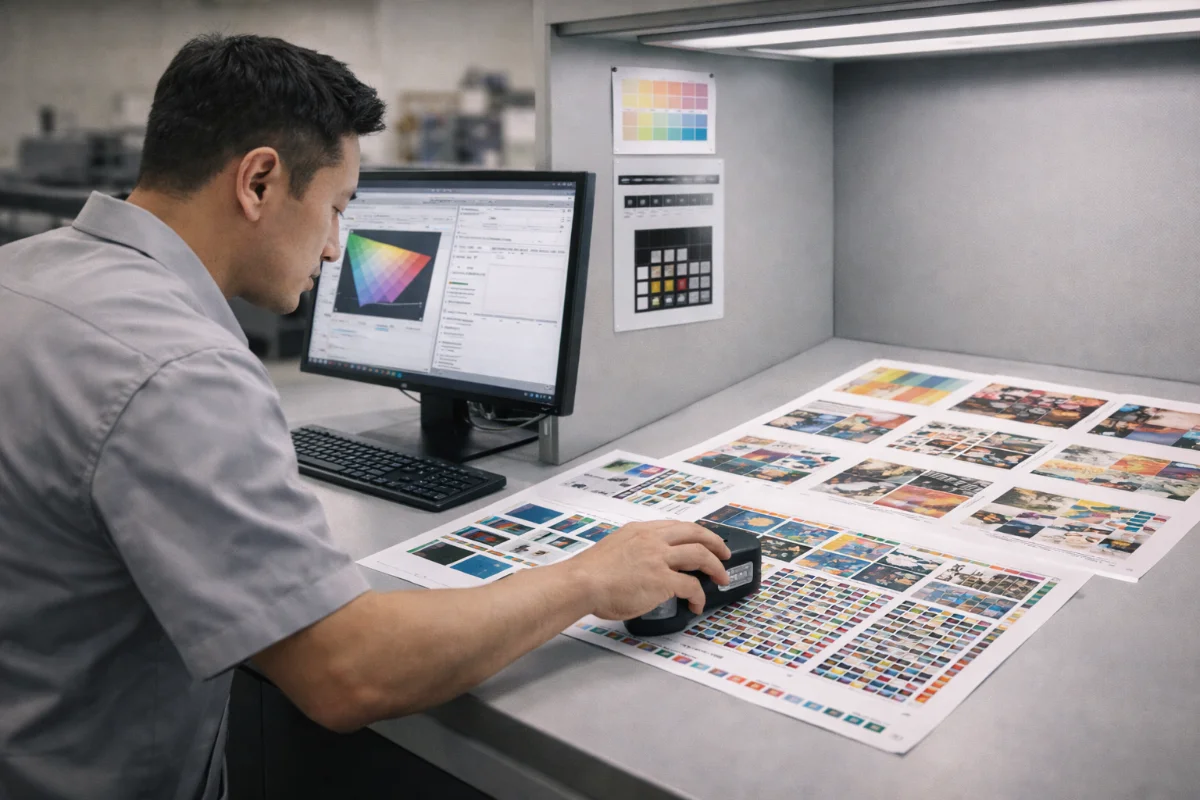
Why Colour Management Matters #
Colour management ensures that the colours you see on screen translate as closely as possible to the final printed result. Because monitors emit light while prints reflect light from ink on paper, discrepancies can occur without controlled workflows.
In commercial printing, colour management systems are used to standardise output across different presses, paper stocks, and finishing processes. This helps maintain consistency for brand-critical projects and large production runs.
The Role of Colour Spaces #
Artwork is typically prepared in colour spaces such as RGB or CMYK. Printing relies primarily on CMYK because inks are layered to reproduce colours physically on paper.
Colour management involves:
-
Converting RGB files to CMYK using defined profiles
-
Controlling black builds
-
Preserving spot colours
-
Adjusting total ink coverage
-
Matching colour appearance across devices
Incorrect colour conversions are a common cause of unexpected results.
ICC Profiles Explained #
ICC profiles describe how a specific device reproduces colour. In printing, profiles are used for:
-
Digital presses
-
Offset presses
-
Proofing printers
-
Specific paper stocks
By embedding the correct ICC profile into artwork or applying it during production, printers can predict how colours will appear and adjust accordingly.
Profiles vary by:
-
Press model
-
Ink set
-
Paper coating
-
Finishing process
Using a generic profile may be acceptable for non-critical jobs, but brand-sensitive projects often require tighter control.
Calibration and Standardisation #
Presses and proofing devices are calibrated regularly to maintain consistent output. Calibration involves:
-
Measuring printed colour patches
-
Adjusting ink densities
-
Aligning colour channels
-
Verifying grey balance
-
Confirming dot gain
Many production environments follow international colour standards to ensure repeatability across jobs and locations.
Types of Proofing Methods #
Proofing is used to preview output before full production begins. Several proofing methods are common.
Soft Proofing #
Soft proofs are digital previews viewed on calibrated monitors. They are useful for:
-
Layout verification
-
Content checks
-
General colour direction
They are limited by screen calibration and viewing conditions and cannot replicate paper texture.
Contract Hard Proofs #
Hard proofs are printed samples generated on colour-managed proofing printers. They are used to:
-
Simulate final colour appearance
-
Represent ink density
-
Provide approval benchmarks
In colour-critical projects, these proofs may serve as contractual references for production.
Press Proofs #
Press proofs involve running a limited number of sheets on the actual production press. They provide the most accurate preview but require significant setup time and cost.
They are typically reserved for:
-
High-value campaigns
-
Packaging
-
Strict brand colour projects
How Paper and Finishing Affect Colour #
Paper surface has a major influence on colour appearance. Coated stocks reflect more light and produce vibrant colours, while uncoated papers absorb ink and appear softer.
Finishing processes can also change colour perception:
-
Lamination can deepen saturation
-
Matte coatings reduce glare
-
Spot UV adds contrast
-
Foil stamping introduces reflective elements
Because of these effects, proofs are often produced on the same stock and finishing configuration as the final job.
Digital vs Offset Colour Control #
Digital presses provide strong consistency across short runs but may have narrower colour gamuts for certain hues.
Offset presses allow greater control over ink mixing and density, which can be beneficial for long runs and brand colours. However, they require careful setup to maintain consistency throughout the run.
Both methods rely heavily on colour management systems to achieve predictable results.
Common Colour-Related Issues #
Typical challenges include:
-
Colour shifts after CMYK conversion
-
Differences between screen and print
-
Paper-induced variation
-
Inconsistent blacks
-
Unexpected tone changes after lamination
These are usually addressed through profiling, proofing, and calibration rather than redesign.
Summary #
Colour management combines calibrated devices, ICC profiles, controlled workflows, and proofing methods to ensure consistent and predictable print results.
Understanding how these systems work helps businesses plan colour-critical projects realistically and choose appropriate proofing levels before production begins.


