
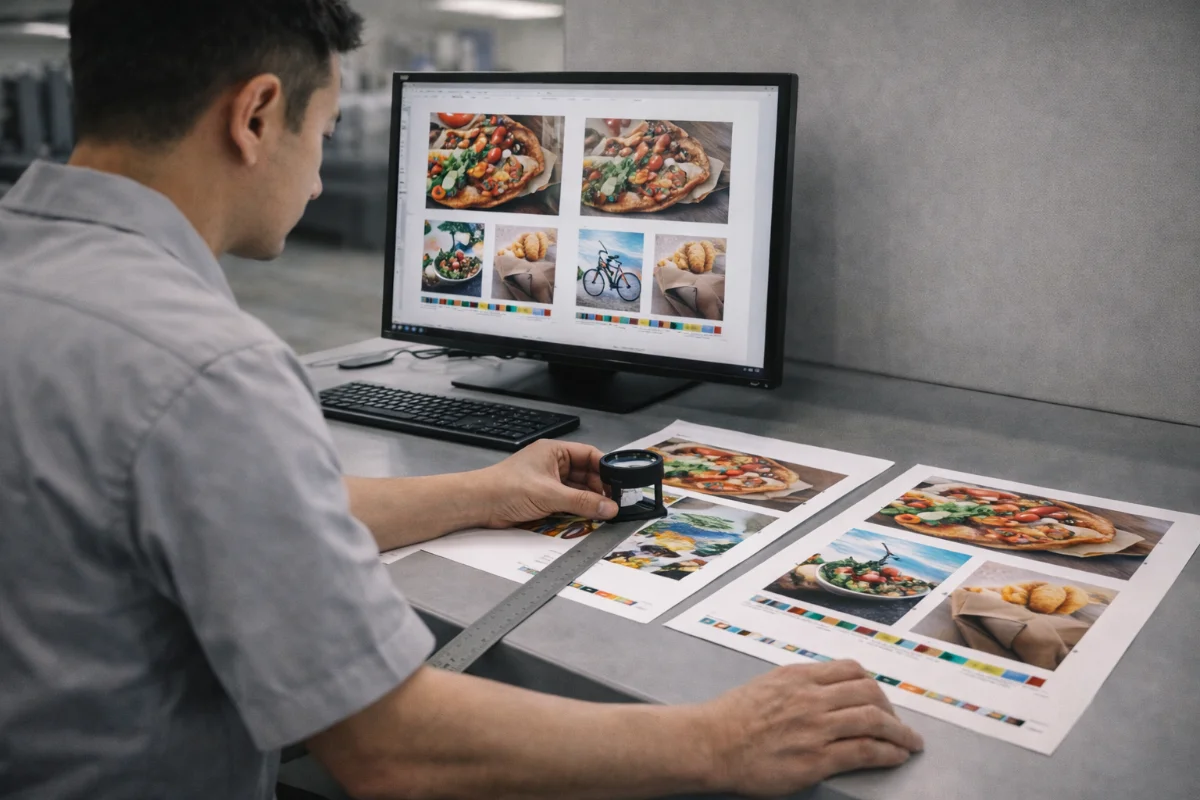
What Proofing Is Designed to Do #
Proofing is a control step used to confirm artwork accuracy before full production begins. It helps identify layout issues, missing elements, pagination errors, and certain colour expectations.
Proofing does not eliminate all production variation, but it significantly reduces the risk of costly mistakes.
Two main types of proofs are used in commercial printing: soft proofs and hard proofs.
What Is a Soft Proof? #
A soft proof is a digital preview, typically delivered as a PDF file for on-screen review.
Soft proofs are commonly used to confirm:
-
Page order
-
Text accuracy
-
Image placement
-
Bleed and trim lines
-
Finishing layers
-
Spot colour separation
They are fast to generate and suitable for most routine jobs.
Limitations of Soft Proofs #
Soft proofs are constrained by:
-
Monitor calibration differences
-
Ambient lighting conditions
-
Screen colour profiles
-
Resolution limitations
Because screens emit light and paper reflects it, colours seen on screen will not match print exactly unless viewed under tightly controlled conditions.
Soft proofs are therefore best for layout verification rather than final colour approval.
What Is a Hard Proof? #
A hard proof is a physical printed sample produced before the main run. It is created on a colour-managed proofing printer or, in some cases, on the actual production press.
Hard proofs are used to:
-
Evaluate colour reproduction
-
Assess paper texture
-
Check finishing interactions
-
Review tonal range and contrast
-
Serve as approval benchmarks
They take longer to produce and may involve additional cost.
Types of Hard Proofs #
Hard proofs can include:
-
Contract proofs from calibrated proofing devices
-
Sample sheets on production presses
-
Bound mock-ups for booklets
-
Finishing samples for coated products
Each type serves a different purpose depending on project risk and budget.
How Proof Type Affects Turnaround #
Soft proofs usually add minimal time because they can be generated quickly.
Hard proofs add time because:
-
Files must be queued on proofing devices or presses
-
Materials must be prepared
-
Finishing may be applied
-
Courier delivery may be required
Production typically does not proceed until the proof is approved, so selecting a hard proof lengthens the overall timeline.
When to Use Each Type #
Soft proofs are usually sufficient when:
-
Layout accuracy is the main concern
-
Colours are not highly critical
-
Quantities are modest
-
Budgets are tight
-
Deadlines are short
Hard proofs are advisable when:
-
Brand colours are sensitive
-
Campaigns are high value
-
Special paper stocks are used
-
Finishing may affect appearance
-
Large quantities are involved
-
Stakeholders require physical sign-off
Digital vs Offset Proofing Differences #
Digital workflows often rely heavily on soft proofs and calibrated proofing printers.
Offset workflows may involve press proofs for colour-critical or long-run projects.
Both rely on colour management systems to keep results predictable.
Approval and Responsibility #
Approving a proof typically means the artwork is accepted as final. After approval:
-
Production begins
-
Changes may require restarting the process
-
Schedules may shift
-
Additional charges may apply
It is important that proofs are reviewed carefully and thoroughly.
Summary #
Soft proofs are fast, convenient previews used mainly for layout verification. Hard proofs are physical samples used to assess colour, paper, and finishing before committing to full production.
Understanding the difference allows businesses to balance speed, cost, and risk appropriately.


