
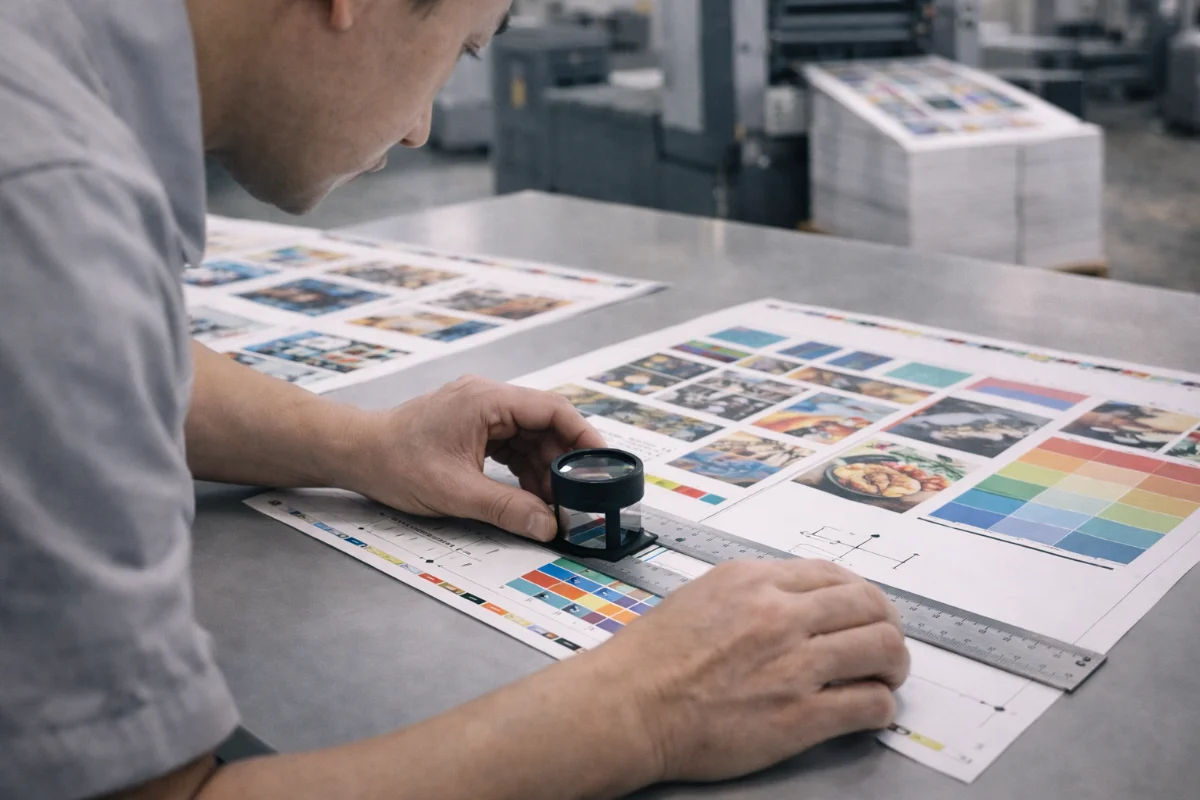
What Are Printing Tolerances? #
Printing tolerances describe the acceptable range of variation that can occur during production without being considered defective. No printing process can achieve absolute precision on every sheet, so small differences in trim position, alignment, and colour density are considered normal.
Registration limits refer specifically to how accurately different colours, layers, or finishing elements line up with one another.
Understanding these concepts helps designers and buyers avoid artwork setups that rely on perfect edge alignment or microscopic details.
Why Variation Occurs in Printing #
Several physical and mechanical factors contribute to minor shifts:
-
Paper expansion and contraction due to humidity
-
Sheet movement during feeding
-
Mechanical vibration
-
Cutting blade tolerances
-
Folding and binding drift
-
Ink spread and absorption
-
Lamination stretch or shrinkage
These variables are managed carefully in production, but they cannot be eliminated entirely.
Common Types of Tolerance in Print #
Trim Tolerance #
When sheets are cut to final size, slight positional differences can occur. Artwork placed too close to edges may be trimmed unevenly.
This is why bleed and safe margins are required.
Colour Registration #
In CMYK printing, multiple ink layers must align perfectly. Minor misregistration can produce thin halos or colour fringes around text and shapes.
Finishing Alignment #
Processes such as Spot UV, die-cutting, hot stamping, and embossing involve separate passes through machinery. Each additional stage introduces potential positional movement.
Folding and Binding #
Multi-page products can shift slightly during folding, stitching, or perfect binding, especially with thick stocks or large page counts.
Digital vs Offset Tolerance Differences #
Both digital and offset printing operate within tolerance ranges, but the causes differ:
-
Digital presses may show variation due to sheet handling or calibration changes.
-
Offset presses may introduce movement during long runs, drying, or multi-pass operations.
Neither method guarantees absolute precision at micro levels.
How Artwork Design Should Account for Tolerances #
Designing with production realities in mind reduces risk.
Best practices include:
-
Keep text at least several millimetres inside trim lines
-
Avoid borders that rely on perfect edge alignment
-
Extend background colours into bleed areas
-
Use thicker strokes rather than hairlines
-
Allow clearance between printed elements and finishing layers
-
Avoid micro text near folds or binding edges
These measures provide visual buffers for natural movement during production.
When Tighter Control Is Needed #
Some projects require closer tolerances than standard workflows can reliably achieve, such as:
-
Packaging with strict fit requirements
-
High-end corporate branding
-
Foil borders near edges
-
Edge-to-edge Spot UV
-
Precision-cut components
These projects often require:
-
Dedicated press runs
-
Press proofs
-
Slower production speeds
-
Additional quality checks
-
RFQ-based planning
How Proofing Helps Manage Expectations #
Proofing allows customers to see how artwork behaves in a real production context. It can highlight:
-
Border alignment risk
-
Folding position drift
-
Colour trapping issues
-
Finishing placement
While proofs reduce uncertainty, they still reflect tolerances rather than guaranteeing perfection.
Typical Tolerance Communication #
Production teams usually specify:
-
Minimum safe margins
-
Bleed requirements
-
Registration allowances
-
Finishing placement limits
These guidelines exist to help designers prepare files that print reliably at scale.
Summary #
Printing tolerances and registration limits are normal aspects of physical production. They arise from paper movement, mechanical processes, and multi-stage finishing.
Designing with safe margins, avoiding edge-critical layouts, and allowing clearance for finishing layers reduces risk and ensures more consistent outcomes.


